


 EN
EN
 AR
AR
 BG
BG
 HR
HR
 NL
NL
 FI
FI
 FR
FR
 DE
DE
 EL
EL
 HI
HI
 IT
IT
 JA
JA
 KO
KO
 NO
NO
 PL
PL
 PT
PT
 RO
RO
 RU
RU
 ES
ES
 SV
SV
 TL
TL
 ID
ID
 SL
SL
 UK
UK
 VI
VI
 GL
GL
 HU
HU
 TH
TH
 TR
TR
 MS
MS
 GA
GA
 CY
CY
 EO
EO
 LA
LA
 MN
MN
 NE
NE
 SO
SO
 UZ
UZ
 HAW
HAW
 LB
LB
Introduction
Light flicker cannot always be seen with the naked eye, but your eyes can definitely feel it. Subtle flickering lights often cause eye strain, dryness, and dizziness. Long-term exposure may even lead to decreased vision. Flicker issues are common not only in office lighting but also in household lamps. This guide shares three easy and practical methods to quickly check whether your light fixtures have harmful flicker problems.
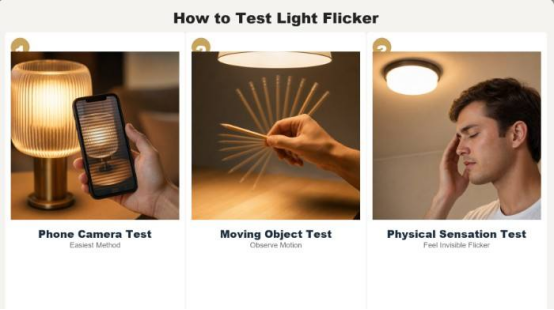
1. Phone Camera Test (Easiest Method)
Open your phone camera and aim it at the illuminated light bulb. If obvious black rolling stripes or wave patterns appear on the screen, the fixture has severe flicker. If no stripes show or the lines are extremely faint, the lamp features good flicker control.
This is the most convenient self-test solution for households. Remember to keep a proper distance and avoid aiming the camera lens directly at overly bright light to prevent lens damage.
2. Moving Object Observation Test
Swiftly wave your fingers under the light. If your fingers appear blurred, doubled, or stutter like slow-motion footage, the light has noticeable flicker. You can also test with an electric fan: if the spinning fan blades look stuck, disjointed, or irregular instead of rotating smoothly, the light source suffers from flicker issues.
3. Physical Sensation Test for Invisible Flicker
Read or work under the lamp for about half an hour. If you feel obvious eye soreness, dryness, or headaches even without visible flashing, you are likely exposed to invisible high-frequency flicker. Never ignore these physical discomfort signals, as hidden flicker causes continuous eye fatigue and visual damage.
Flicker Causes and Effective Solutions
Light flicker is mainly caused by low-quality driver power supplies or mismatched dimmers. Replacing with a high-quality professional driver is the fundamental solution. For dimmable lights, always confirm compatibility between the dimmer and light source.
To avoid hidden eye risks, it is highly recommended to choose formal flicker-free certified light fixtures. Replace severely flickering lamps in a timely manner to protect long-term eye health.
Final Thoughts
Most harmful light flicker is invisible but damaging. With a phone camera, simple object movement observation, and physical feedback judgment, anyone can easily detect unqualified lighting at home. Eliminating flicker through upgraded drivers and standard flicker-free lamps creates a healthier and more comfortable lighting environment for daily work and reading.