


 EN
EN
 AR
AR
 BG
BG
 HR
HR
 NL
NL
 FI
FI
 FR
FR
 DE
DE
 EL
EL
 HI
HI
 IT
IT
 JA
JA
 KO
KO
 NO
NO
 PL
PL
 PT
PT
 RO
RO
 RU
RU
 ES
ES
 SV
SV
 TL
TL
 ID
ID
 SL
SL
 UK
UK
 VI
VI
 GL
GL
 HU
HU
 TH
TH
 TR
TR
 MS
MS
 GA
GA
 CY
CY
 EO
EO
 LA
LA
 MN
MN
 NE
NE
 SO
SO
 UZ
UZ
 HAW
HAW
 LB
LB
Introduction
When sourcing decorative pendant lights, chandeliers, and flush mounts, buyers often face huge price differences between visually identical brass-style fixtures. Many clients cannot tell solid brass lighting apart from brass-plated products simply from website photos. In fact, the material difference is the core reason for quality gaps, service life differences, and project stability variation. Below we break down why genuine solid brass fixtures outperform brass-plated alternatives for residential and commercial lighting projects.
1. Completely Different Corrosion and Oxidation Resistance
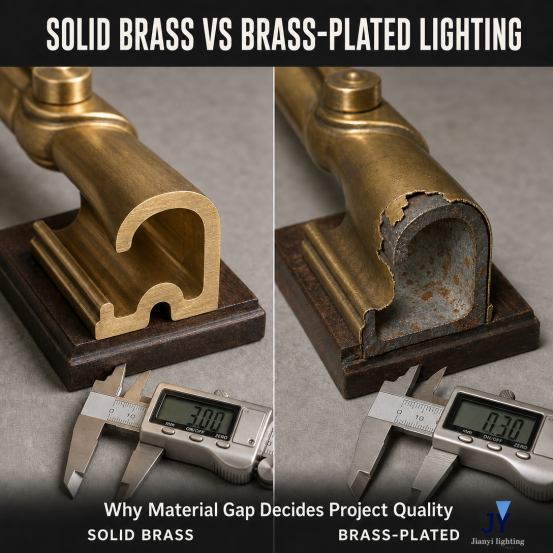
Brass-plated fixtures adopt iron or steel base material with only a thin electroplated brass layer. After long-term use in humid indoor environments, coastal areas, or high-humidity commercial spaces, the thin plating layer easily fades, peels off, and oxidizes. Exposed base metal gradually turns black and rusty, destroying the whole lighting appearance within several years.
Our solid brass lighting adopts genuine thick brass material with highly stable chemical properties. The integrated brass structure will never rust, peel, or fade. It effectively resists moisture corrosion, air oxidation, and daily environmental erosion, maintaining a smooth and uniform surface condition for decades.
2. Structural Stability and Load-Bearing Gap
Brass-plated lamps rely on soft iron or steel substrates. Welding points are easy to loosen, deform, and shake after long-term suspension, resulting in unstable installation, tilt, or even safety hazards. Most plated fixtures use thin materials to reduce costs, leading to weak overall structural toughness.
Genuine solid brass fixtures feature high density, strong toughness, and excellent load-bearing performance. All frame structures, lamp arms, and mounting parts are integrally crafted with thickened brass. The whole lamp structure is firm, shock-resistant, and deformation-proof. It avoids loosening, shaking, and sagging problems during long-term hanging use.
3. Inherent Luster vs Coating-Dependent Surface Effect
All brass-plated lighting effects depend entirely on external electroplating paint. The surface gloss is artificial and superficial. After temperature changes, light friction, and long-time illumination aging, the coating turns yellow, dim, and uneven, making the lamp look old and low-grade.
Solid brass lighting owns inherent metallic luster instead of external paint decoration. Through professional multi-layer polishing and anti-oxidation treatment, the brass surface maintains a delicate and high-end texture permanently. With the passage of time, solid brass forms a natural vintage patina, improving the decorative effect instead of depreciating.
4. Service Life and Long-Term Cost Performance
Brass-plated lighting is cheap initially but requires frequent replacement within 3–5 years due to oxidation, peeling, and structural aging. For hotel projects, commercial spaces, and high-end villas, frequent replacement causes high secondary maintenance costs and project losses.
Although solid brass lighting has a higher initial investment, it delivers ultra-long service life up to 15–20 years with almost no maintenance. Stable material performance and permanent decorative effect bring far better long-term cost performance for batch engineering projects and high-end residential decoration.
Final Thoughts
The essential difference between solid brass lighting and brass-plated lighting lies in material purity, structural stability, and anti-aging performance. Brass-plated products only simulate appearance, while genuine solid brass fixtures provide permanent durability, stable structure, and escalating texture. For buyers pursuing high-end decorative quality and long-term project stability, solid brass lighting is the most reliable long-term lighting solution.