



 EN
EN
 AR
AR
 BG
BG
 HR
HR
 NL
NL
 FI
FI
 FR
FR
 DE
DE
 EL
EL
 HI
HI
 IT
IT
 JA
JA
 KO
KO
 NO
NO
 PL
PL
 PT
PT
 RO
RO
 RU
RU
 ES
ES
 SV
SV
 TL
TL
 ID
ID
 SL
SL
 UK
UK
 VI
VI
 GL
GL
 HU
HU
 TH
TH
 TR
TR
 MS
MS
 GA
GA
 CY
CY
 EO
EO
 LA
LA
 MN
MN
 NE
NE
 SO
SO
 UZ
UZ
 HAW
HAW
 LB
LB
Introduction
Many homeowners purchase dimmable bulbs or lighting fixtures without fully understanding what “dimmable” actually means. As a result, they often experience problems such as flickering lights, buzzing sounds, inconsistent brightness, or fixtures that simply refuse to dim properly.
Understanding the difference between dimmable and non-dimmable lighting is essential when choosing lighting for your home. The right setup can improve comfort, create the perfect atmosphere, and enhance the overall functionality of a space.
This guide explains the key differences between dimmable and non-dimmable lights, how dimming systems work, and how to choose the right option for different areas of your home.
1. Dimmable Lights Allow Adjustable Brightness and Mood Control
The main advantage of dimmable lighting is flexibility.
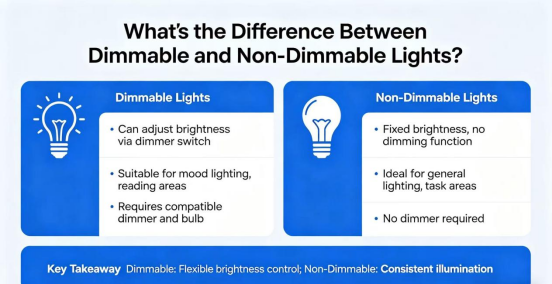
Dimmable lights allow you to adjust the brightness level according to your needs — from soft ambient lighting to full brightness for daily activities. Using a compatible dimmer switch, homeowners can easily create different moods and lighting atmospheres throughout the day.
For example:
* Lower brightness creates a warm and relaxing environment for evenings
* Medium brightness works well for everyday comfort
* Full brightness is useful for cleaning, reading, or task lighting
This makes dimmable lighting especially popular in:
* Living rooms
* Dining rooms
* Bedrooms
* Home theaters
* Luxury interior spaces
Dimmable LED lighting is also commonly used in modern chandeliers, pendant lights, wall sconces, and recessed lighting systems because it offers both energy efficiency and lighting flexibility.
2. Non-Dimmable Lights Are Simpler and More Cost-Effective
Not every space requires adjustable brightness. In many functional areas of a home, simple on/off lighting is perfectly sufficient.
Non-dimmable lights are generally more affordable and easier to install because they do not require specialized dimmer switches or compatible dimming systems. They are often a practical choice for areas where consistent brightness is preferred at all times.
Common applications for non-dimmable lighting include:
* Hallways
* Closets
* Garages
* Storage rooms
* Utility spaces
* Outdoor security lighting
Because of their simplicity, non-dimmable fixtures can also reduce compatibility concerns and installation complexity.
For homeowners who only need reliable everyday lighting without additional lighting control features, non-dimmable lighting remains an efficient and budget-friendly solution.
3. Dimming Requires Both a Compatible Bulb and Dimmer Switch
One of the most common misunderstandings about dimmable lighting is assuming that a dimmable bulb alone is enough to create dimming functionality. In reality, proper dimming requires compatibility between both the light source and the control system.
To achieve smooth dimming performance, you need:
* A dimmable bulb or dimmable LED driver
* A compatible dimmer switch designed for that lighting type
If a dimmable bulb is connected to a standard non-dimming switch, it will simply operate at full brightness without dimming capability.
On the other hand, using a non-dimmable bulb with a dimmer switch can cause several issues, including:
* Flickering
* Buzzing sounds
* Unstable brightness
* Reduced bulb lifespan
* Complete lighting failure
This is especially important with LED lighting, as LED dimming compatibility depends heavily on both the driver and dimmer technology being used.
Choosing properly matched components helps ensure stable performance, smooth dimming transitions, and long-term reliability.
Final Thoughts
Both dimmable and non-dimmable lighting have their advantages depending on the purpose of the space.
Dimmable lighting offers greater flexibility, atmosphere control, and comfort, making it ideal for living rooms, bedrooms, dining areas, and decorative lighting applications. Non-dimmable lighting, meanwhile, provides a simpler and more economical solution for utility-focused spaces where adjustable brightness is unnecessary.
Most importantly, always ensure that your bulbs, LED drivers, and dimmer switches are fully compatible with each other. Understanding this simple difference can help you avoid common lighting problems and choose the best lighting solution for your home.