


 EN
 AR
 BG
 HR
 NL
 FI
 FR
 DE
 EL
 HI
 IT
 JA
 KO
 NO
 PL
 PT
 RO
 RU
 ES
 SV
 TL
 ID
 SL
 UK
 VI
 GL
 HU
 TH
 TR
 MS
 GA
 CY
 EO
 LA
 MN
 NE
 SO
 UZ
 HAW
 LB
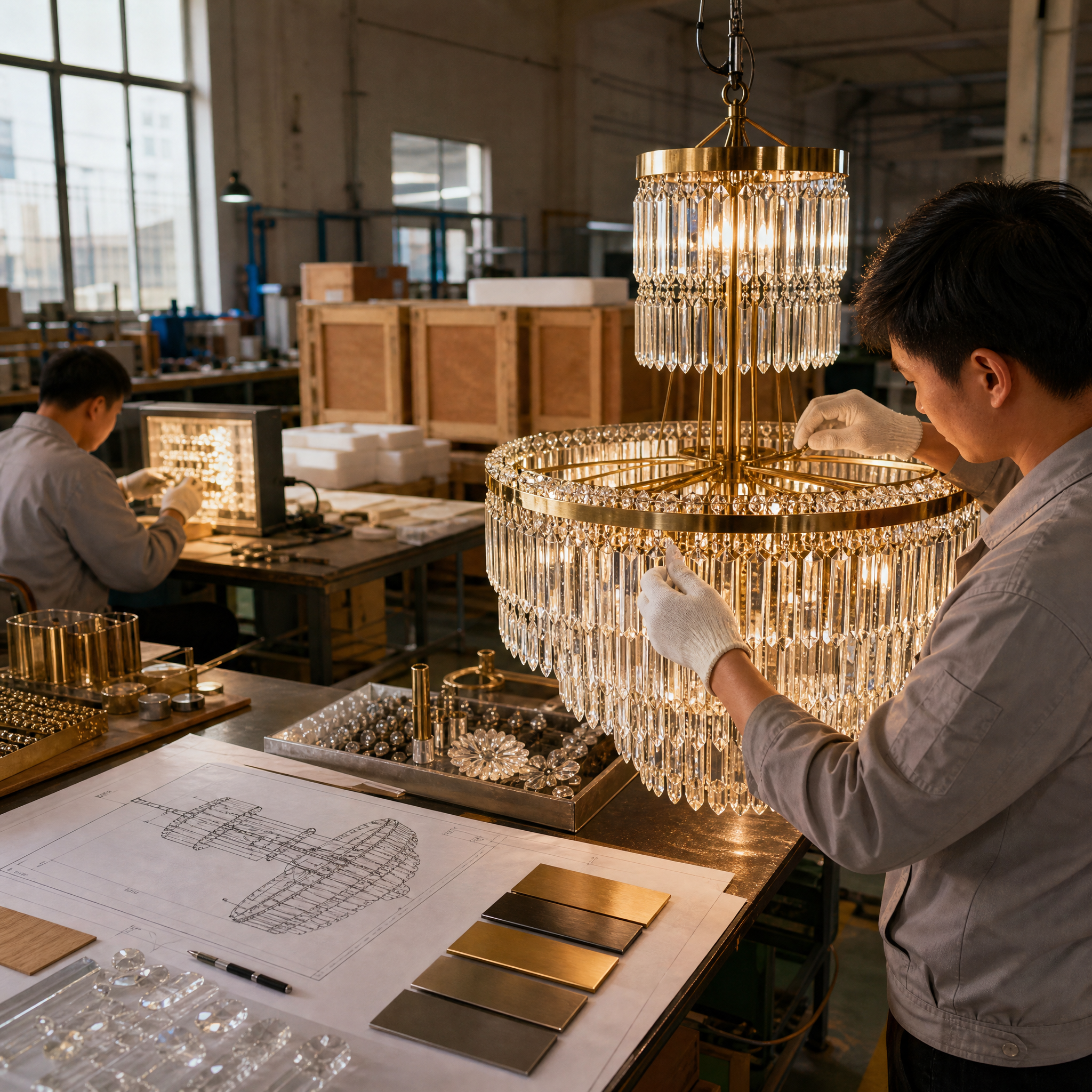
How to Choose a Custom Lighting Manufacturer in China: A Buyer’s Checklist
Introduction
Sourcing custom chandeliers, wall sconces and decorative lighting from China gives interior designers, hotel contractors, lighting brands and wholesale buyers access to flexible OEM & ODM capabilities, competitive pricing and rich material options. However, many buyers run into delays, inconsistent finishes, fragile shipments or miscommunication when working with trading companies instead of qualified manufacturers.
This step-by-step checklist helps you filter, evaluate and confirm a trustworthy custom lighting factory before you approve samples or place bulk orders. It covers factory verification, project portfolio, custom workflow, material options, quality testing, export packaging, installation support and red flags to avoid.
1. Check whether it is a real factory
Many suppliers online are trading companies that outsource production. A genuine factory owns its workshop, assembly lines, testing equipment and fixed production team.
What to verify:
- Business license, factory address, on-site video tour or virtual factory audit
- Independent workshop for metal bending, welding, glass blowing, crystal assembly and finishing
- In-house QC and aging test stations, not only a showroom
- Ask if they accept third-party inspection before shipment
A real factory controls lead time, cost adjustment and revision flexibility. Trading agents often cannot fix technical issues quickly when problems appear.
2. Review project experience
Custom decorative lighting is highly project-driven. A factory that only makes standard mass-market lights may struggle with non-standard sizes, special metal finishes or layered crystal layouts.
Request case references matching your niche:
- Luxury hotel lobbies, restaurant islands, villa stairwells, residential statement chandeliers
- Photos, site installation pictures, client names (if available) and dimension sheets of finished custom jobs
- Whether they have delivered similar large or high-end custom lighting to your target market
Focus on factories with repeat commercial project experience; they anticipate common construction and compliance requirements.
3. Ask about customization workflow
Clear custom workflows prevent endless back-and-forth and sample rework. A mature factory should walk you through every stage from concept to delivery.
A reliable custom process usually includes:
- Concept / reference photo or CAD drawing review
- Engineering feasibility feedback (structural safety, weight, ceiling load)
- Quotation with material list, finish specification and MOQ
- Sample production, photo confirmation or physical sample approval
- Pre-production sample sign-off
- Mass production, inline QC and burn-in testing
- Pre-shipment inspection, packing and loading
Confirm who handles engineering revisions, how many revision rounds are included, and the timeline for samples.
4. Confirm materials and finish options
Custom lighting disputes most often happen on material grade and surface finish. Everything must be written clearly in your quotation and sample sheet.
Common custom lighting options to confirm:
- Metal: Aged brass, vintage brass, dark bronze, rose gold, black-gold trim, powder coating
- Decorative elements: Clear crystal, prism glass, hand-blown glass spheres, textured ripple glass
- Cables, chains, canopy hardware and bulb sockets
- Pantone color matching, brushed, polished, antique or distressed finishes
- Tolerance standard for color difference between batches
Ask for physical finish swatches before sampling. Do not rely only on renderings.
5. Review QC and aging test process
Decorative lighting combines electrical safety and cosmetic appearance. A strict QC system catches defects before shipping.
Key questions to ask:
- Is every fixture powered for aging / burn-in test, or only spot sampling?
- How long is the aging test cycle?
- Inspection stages: incoming material check, inline assembly check, final visual + electrical test
- Compliance documents for your market: CE, RoHS, UL / ETL test reports if required
- Rework procedure for scratched frames, loose crystals or flickering issues
For high-value custom chandeliers, 100% burn-in testing is strongly recommended.
6. Check packaging for overseas shipping
Custom crystal and glass lighting is fragile. Poor packaging is one of the top reasons for breakage during sea freight.
Qualified export packaging includes:
- Individual foam wrapping for glass, crystal and delicate metal parts
- Reinforced export cartons, sometimes wooden crates for large chandeliers
- Drop-test packaging design for long ocean transit
- Clear labeling, packing list and separate accessory box for chains, canopy and mounting hardware
- Container loading supervision for big orders
Ask the factory to share packing photos of past shipped custom lights.
7. Ask for installation support
Custom lighting is frequently large, heavy or multi-piece. Even if your local team installs it, the factory should provide technical support.
Check what they supply:
- Detailed installation manual, dimension drawing and hanging diagram
- Assembly videos for layered chandeliers
- Spare crystals, glass drops or replacement hardware included
- Remote technical guidance during installation
Avoid factories that cannot provide drawings or assembly guidance for non-standard custom pieces.
8. Compare communication quality
Good communication directly reduces custom project risks. Watch these signals during your early stage:
- Do they respond with clear technical answers, or only vague sales replies?
- Can they understand architectural drawings, finish requirements and project deadlines?
- Are specifications, lead time and change requests recorded in writing?
- Do they proactively flag structural risks or material limitations instead of promising everything?
Slow, inconsistent or over-promising communication usually leads to bad samples and delayed shipments.
9. Warning signs to avoid
Watch for these red flags before you commit to a custom lighting order:
- Refuses factory tour, virtual audit or third-party inspection
- Gives extremely low prices without listing material and finish details
- Cannot provide relevant test certificates for your target market
- Promises unlimited free revisions with no clear sample approval process
- Cannot show similar custom project references
- Asks for full payment upfront before sample confirmation
- Avoids discussing packaging, breakage responsibility or spare parts policy
10. Final checklist before confirming your custom lighting manufacturer
☐ Verified real factory, not a pure trading company
☐ Relevant hotel / villa / commercial custom lighting portfolio
☐ Documented custom workflow and sample approval rules
☐ Confirmed material list + finish swatches
☐ Clear aging test, QC and compliance plan
☐ Export-grade anti-breakage packaging solution
☐ Installation drawings, manuals and spare part policy
☐ Stable, detailed written communication
☐ No major red flags identified
Conclusion
Custom lighting sourcing is not only about price. The best Chinese custom lighting factory balances design translation, structural engineering, consistent finishing, strict quality testing and export-safe packaging. Use this checklist at your first inquiry stage, and you will greatly reduce sample failure, shipping damage and project delays for your residential, hospitality and commercial lighting projects.
Table of Contents
- Introduction
- 1. Check whether it is a real factory
- 2. Review project experience
- 3. Ask about customization workflow
- 4. Confirm materials and finish options
- 5. Review QC and aging test process
- 6. Check packaging for overseas shipping
- 7. Ask for installation support
- 8. Compare communication quality
- 9. Warning signs to avoid
- 10. Final checklist before confirming your custom lighting manufacturer
- Conclusion